
Schön, Donald A (1983)
Basic Books, 374 pages
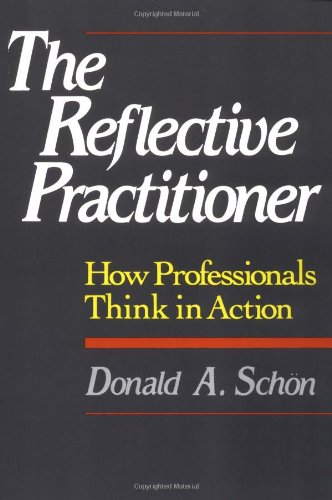 Overall rating: Superb
Strengths: Foundational piece of literature for any professional who wishes to practise reflectively within their area of expertise, adapting their thought process to problems contained within their practise
Weakness: The work is slightly dense reading at times, providing more examples than required
Audience: All professionals who wish to practise reflectively and educators who wish to teach reflective practise
In The Reflective Practitioner, Schön provides his view point on the unconscious methodology successful professionals use to understand and adapt to the problems encountered within their practises. Initially, he provides an analysis of the limitations of Technical Rationality, the classical epistemology of professional practise, whereby he shows how the hierarchical and expert-based system driving much of the professional practise ill equips practitioners with the skills to handle complex multivariable problems occurring in life. Schön then states how successful practitioners reflect-in-action to approach these problems by:
- Reframing problems to yield new discoveries
- Experimenting with the problem and testing hypotheses
- Bringing past experience to bear on unique situations
- Creating virtual worlds to test new theorems
- Shifting their stance towards inquiry
Finally, Schön provides of myriad of evidence from varying professions ranging from psychology, town planning, architecture and others to show how these techniques have been effectively applied by reflective practitioners to find unique solutions to problems lacking straight forward answers. Given the era this piece was written in, the author is prescient in his predictions of how contemporary physicians now apply reflection-in-action by applying the biopsychosocial model of medicine to treat each patient uniquely. In summary, this novel is excellent. At multiple points I felt there were lessons that could be applied to my own practises in medicine and education. I would recommend this to any professional striving towards self-improvement or teaching the future generation.
 Laurence Biro's reflections on Life, Universe and Everything