
Moira Stewart, Judith Belle Brown, W Wayne Weston, Ian R McWinney, Carol L McWilliam and Thomas R Freeman
Radcliff Publishing, 426 pages, 2014
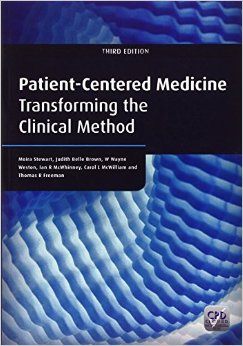 Overall rating: Exceptional
Strengths: Foundational piece of literature for providing a theoretical construct for clinician-patient interaction
Weakness: Neglects the biomedical model of medicine to the point of irrelevancy
Audience: All clinician and clinician-teachers who wish to focus their clinical style on the patient rather than solely on the disease
Most clinicians practise using the traditional biomedical approach to patient care. In this traditional approach the differential diagnosis and the disease are at the centre of the clinical method and the patient experience is ignored. In Patient-Centred Medicine, Stewart et al turns this approach on its head. The clinical method is refocused around the patient experience rather than the disease. The first half of the text uses evidence to provide both an approach and practical tips to practise patient-centred medicine. This includes:
- Understand the whole person
- Appreciating the patient context
- Enquiring into the illness experience
- Finding Common Ground
- Enhancing the clinician-patient relationship
The second half of the book is of particular interest to educators as it applies the earlier constructs to students to develop a learner-centred approach to teaching the clinical method. Stewart et al cover both the educational theory and practical methods required to improve the learner experience. Of particular note is the section that reviews multiple easily applicable strategies to the clinical teaching environment.
The major shortcoming of Patient-Centred Medicine is the minimization of the biomedical model of medicine to the point of irrelevancy. It is this reviewer’s belief that both models are equally important for providing clinical care for patients – clinicians can only help patients if there is understanding of both the patient and the disease. Furthermore learners should be encouraged weave back and forth between the biomedical and patient-centred model as appropriate – ignoring neither.
 Laurence Biro's reflections on Life, Universe and Everything