Category Archives: Book Reviews

The Medical Interview – Mastering Skills for Clinical Practice

Fifth Edition (2006)

John Coulehan and Marian Block

F.A. Davis Company, 409 pages

Overall rating: Sadly flawed

Strengths: Offers a good breadth of practical skills to apply to the medical interview

Weakness: Uses clinician to clinician communication as a basis of understanding patient to clinician communication

Audience: Junior Medical Learners

The medical interviewThe Medical Interview is a commonly used book for teaching junior medical learners the basic methods of interviewing patients.  It contains a wide variety of well explained skills in regards to variety of aspects of communication with patients.  It has good advice in regards to adolescents, geriatrics, cultural competence and breaking bad news. In particular, its descriptions of the empathic cycle and empathic levels of responding are excellent.  Categorizing responses as ignoring, minimizing, interchangeable and additive gives learners a comprehensible framework of how to respond to patients’ feelings and emotions rather than with rote statements such as “I’m sorry,” or “that must be very difficult.”

Despite the plethora of excellent content contained within The Medical Interview, Coulehan and Block make the same tragic mistake of organizing the interview based clinician to clinician communication rather than clinician to patient communication.  The major sections of the text are components of the case report which gives the mistaken impression that medical interviews should flow based on that paradigm rather than the freer flowing and messier interaction that patient centred interviewing requires.  I worry that following this text would make learners’ interviews far more rigid as they try to keep with this set structure.  This book is also challenging to use from a curricular perspective.  There is no attempt to provide a bird’s eye model of communication that can be easily remembered and diagrammed.  Its content, while organized, is not layered in a way to facilitate recall.

I think the numerous ideas contained within The Medical Interview has value as a reference text but not as the framework to understand the medical interview.  I would discourage learners from using this as a structure to understand how to communicate with patients as its methods can potentially lead to the flawed communication style frequently seen within health care.  I believe undergraduate medical curricula are better served by utilizing other texts.

Teaching and Learning Communication Skills in Medicine

Second Edition (2005)

Suzanne Kurtz , Jonathan Silverman, Juliet Draper

Radcliff Publishing, 369 pages

Overall rating: Epic

Strengths: Foundational piece of literature that informs the organized teaching and learning of patient-physician communication

Teaching and learning communcation skillsWeakness: Neglects the patient centred content of the interview

Audience:  Clinician-teachers and communication program directors

Teaching and Learning Communication Skills in Medicine is the companion book to Skills for Communicating with Patients.  It takes the theoretical constructs used to understand the clinician-patient interaction and shows how to teach and learn them.  The book starts at the basics examining the why, how and what to teach and moves to progressively more complex areas.  Subjects span:

  • Creating structure for learners
  • Running small groups session
  • Providing feedback
  • Utilizing technology
  • Developing a communications curriculum
  • Supporting faculty in a communication curriculum

The authors use a rich array of educational theory to support the ideas they advocate.  In particular, they draw about Kolb’s ideas about experiential learning to underlie their thesis.  The most interesting idea they advocate is flipping the skills used for clinician-patient interaction to parallel and direct clinician-learner interactions.  This book balances well the theoretical aspects with practical and easily implementable teaching methods.

The only short comings of Kurtz et al’s ideas lie in the same challenges of their original book – the lack of attention given to patient-centred content.  Nonetheless, this book is excellent.  I feel using the knowledge contained within its pages will significantly enhance my teaching methodologies and ability to write curriculum.  I think this book would be extremely valuable for all clinician-teachers and is a must read for all communication course directors.

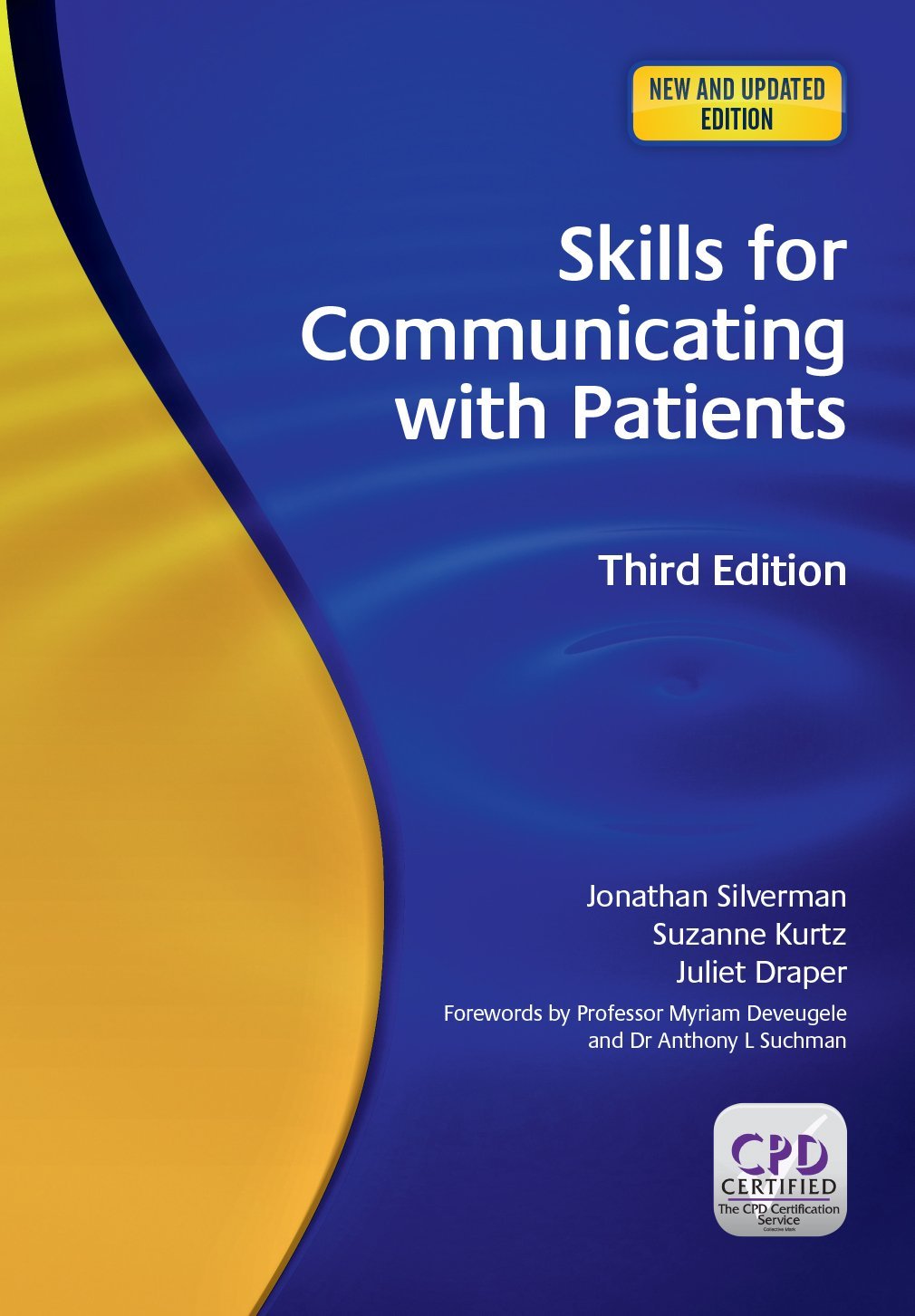
Skill for Communicating with Patients

Third Edition (2013)

Jonathan Silverman, Suzanne Kurtz, Juliet Draper

Radcliff Publishing, 305 pages

Overall rating: Mind-blowing

Strengths: Foundational piece of literature that transforms patient-physician communication into a learnable set of skills

Weakness: Neglects the skills for communicating with patientspatient centred content of the interview

Audience: Clinicians, clinician-teachers and medical learners who wish to improve their interactions with patients

Unlike clinician-clinician communication, the patient-clinician interaction is messy.  Clinicians have many years of training that allow colleagues to communicate to each other using specialized terminology and structures that enable fast, meaningful and deep conversations.  Patients do no have these structures and communicate based on the vantage point of their illness experience.  It is our roles as clinician to be able to listen and provide structure to enable patients to communicate their entire story while ensuring the patient feels heard.  Unfortunately, the structure of the clinician-clinician interaction (the case report – ID, CC, HPI, PMHx, Meds, etc…) has become the basis of teaching communication with patients.

Silverman et al re-examines the patient-clinician interaction by discarding the traditional case report as basis of understanding this interaction.  This piece correctly identifies the three major themes that need to be addressed to understand how physicians communicate with patients:

  • Content skills – what information needs to be conveyed
  • Process skill – how the information is communicated
  • Perceptual skills – what the clinician is thinking while communicating

An overarching framework is given to understand these skills is given through the Calgary-Cambridge Guide to enable these skills to be committed to memory.  Silverman et al go into depth exploring over seventy easily understood process skills that broadly break down into initiating the interview, gathering information, physical examination, explanation and planning, closing the session, providing structure and finally building the relationship.

Overall this book is excellent.  It provides structure to the chaotic interview.  Many of the skills contained within the pages I have been doing already but many I have not.  Reading this piece will significant improve my communication with patients.  The major fault of the methods proposed is lack of patient-centred content.  While this book has considerable overlap with Stewart et al’s work in Patient-Centred Medicine, it mostly ignores the non-medical patient context (ie. determinants of health).  The Calgary-Cambridge teaching tools can be significantly strengthened by the addition of patent centred content. While I believe together Skills for Communicating with Patients and Patient-Centred Medicine can form the foundation of any communication curriculum, neither is inclusive enough to stand on its own.

Patient-Centred Medicine Transforming the Clinicial Method (Third Edition)

Moira Stewart, Judith Belle Brown, W Wayne Weston, Ian R McWinney, Carol L McWilliam and Thomas R Freeman

Radcliff Publishing, 426 pages, 2014

Patient Centred MedicineOverall rating: Exceptional

Strengths: Foundational piece of literature for providing a theoretical construct for clinician-patient interaction

Weakness: Neglects the biomedical model of medicine to the point of irrelevancy

Audience: All clinician and clinician-teachers who wish to focus their clinical style on the patient rather than solely on the disease

Most clinicians practise using the traditional biomedical approach to patient care.  In this traditional approach the differential diagnosis and the disease are at the centre of the clinical method and the patient experience is ignored.  In Patient-Centred Medicine, Stewart et al turns this approach on its head.  The clinical method is refocused around the patient experience rather than the disease.  The first half of the text uses evidence to provide both an approach and practical tips to practise patient-centred medicine.  This includes:

  • Understand the whole person
  • Appreciating the patient context
  • Enquiring into the illness experience
  • Finding Common Ground
  • Enhancing the clinician-patient relationship

The second half of the book is of particular interest to educators as it applies the earlier constructs to students to develop a learner-centred approach to teaching the clinical method.  Stewart et al cover both the educational theory and practical methods required to improve the learner experience.  Of particular note is the section that reviews multiple easily applicable strategies to the clinical teaching environment.

The major shortcoming of Patient-Centred Medicine is the minimization of the biomedical model of medicine to the point of irrelevancy.  It is this reviewer’s belief that both models are equally important for providing clinical care for patients – clinicians can only help patients if there is understanding of both the patient and the disease.  Furthermore learners should be encouraged weave back and forth between the biomedical and patient-centred model as appropriate – ignoring neither.

Educating the Reflective Practitioner

Schön, Donald A (1987), Josey-Bass, 355 pages

Educating the Reflective PractitionerOverall rating: Has promise, but frustrates the core message

Strengths: Foundational piece of literature for any educator of reflective professionals

Weakness: This work is very dense, delving too much into specific examples rather than exploring the theoretical framework that can be applied to different professionals

Audience: All professional educators who wish to teach their learners to reflect-in-action by implementing reflective practicums in their respective curriculum

In Educating the Reflective Practitioner, Schön instructs how his theory of reflection-in-action can be taught to professional learners through coaching and implementing reflective practicums. Schön initially reiterates his original work to quickly reaffirm his thesis from The Reflective Practitioner (1983) – that successful practitioners must constantly reflect to deal with the messy challenges of real world problems. He then discusses the methodologies used by coaches to move learners from the mystery on exposure to a novel subject to ultimate mastery. This includes:

  • Joint experimentation – working to achieve desired goals through collaborative inquiry of a new situation
  • Follow me – breaking the whole into local units of reflection-in-action to demonstrate interplay between a whole problem and its constituents
  • Hall of Mirrors – where the interaction of the learner and coach becomes a reflection of the interaction of the learner and problem

Schön then moves on to demonstrate the promises and challenges of moving these dialogues from the individual to systemic level through the implementation of reflective practicums within professional curriculum. Given the multiple stakeholders and institutionalized resistance to change at many schools, he correctly identifies multiple barriers to the implementation of his ideas.

While this work shows great promise as an educational teaching tool, it is ultimately flawed due to its overwhelming detail within specific examples. Schön’s theoretical discussions are understandable with a moderate amount of concerted thought. However, for the majority of the book he delves deeply into case examples ranging from architecture, music and psychotherapy where knowledge of these fields is necessary to comprehend the vignettes. This ultimately confounds the message and causes the forest to be lost from the trees.  While I would recommend this book for any educator of professionals, I do so with hesitation.

The Reflective Practitioner, How Professionals Think in Action

Schön, Donald A (1983)

Basic Books, 374 pages

Schon1Overall rating: Superb

Strengths: Foundational piece of literature for any professional who wishes to practise reflectively within their area of expertise, adapting their thought process to problems contained within their practise

Weakness: The work is slightly dense reading at times, providing more examples than required

Audience: All professionals who wish to practise reflectively and educators who wish to teach reflective practise

In The Reflective Practitioner, Schön provides his view point on the unconscious methodology successful professionals use to understand and adapt to the problems encountered within their practises. Initially, he provides an analysis of the limitations of Technical Rationality, the classical epistemology of professional practise, whereby he shows how the hierarchical and expert-based system driving much of the professional practise ill equips practitioners with the skills to handle complex multivariable problems occurring in life. Schön then states how successful practitioners reflect-in-action to approach these problems by:

  • Reframing problems to yield new discoveries
  • Experimenting with the problem and testing hypotheses
  • Bringing past experience to bear on unique situations
  • Creating virtual worlds to test new theorems
  • Shifting their stance towards inquiry

Finally, Schön provides of myriad of evidence from varying professions ranging from psychology, town planning, architecture and others to show how these techniques have been effectively applied by reflective practitioners to find unique solutions to problems lacking straight forward answers. Given the era this piece was written in, the author is prescient in his predictions of how contemporary physicians now apply reflection-in-action by applying the biopsychosocial model of medicine to treat each patient uniquely. In summary, this novel is excellent. At multiple points I felt there were lessons that could be applied to my own practises in medicine and education. I would recommend this to any professional striving towards self-improvement or teaching the future generation.