
Active reflection has become an integral component of my clinical practice over the course of my medical training. The development of the skill has allowed me to understand the struggles and challenges I have had as I developed into an independent physician. It has given me the chance to look at road bumps and determine the underlying causes. Reflection became the lens I looked through to help me understand my difficulties, pose questions and develop solutions. I consider my reflective skill set a core competency for success in life and medicine.
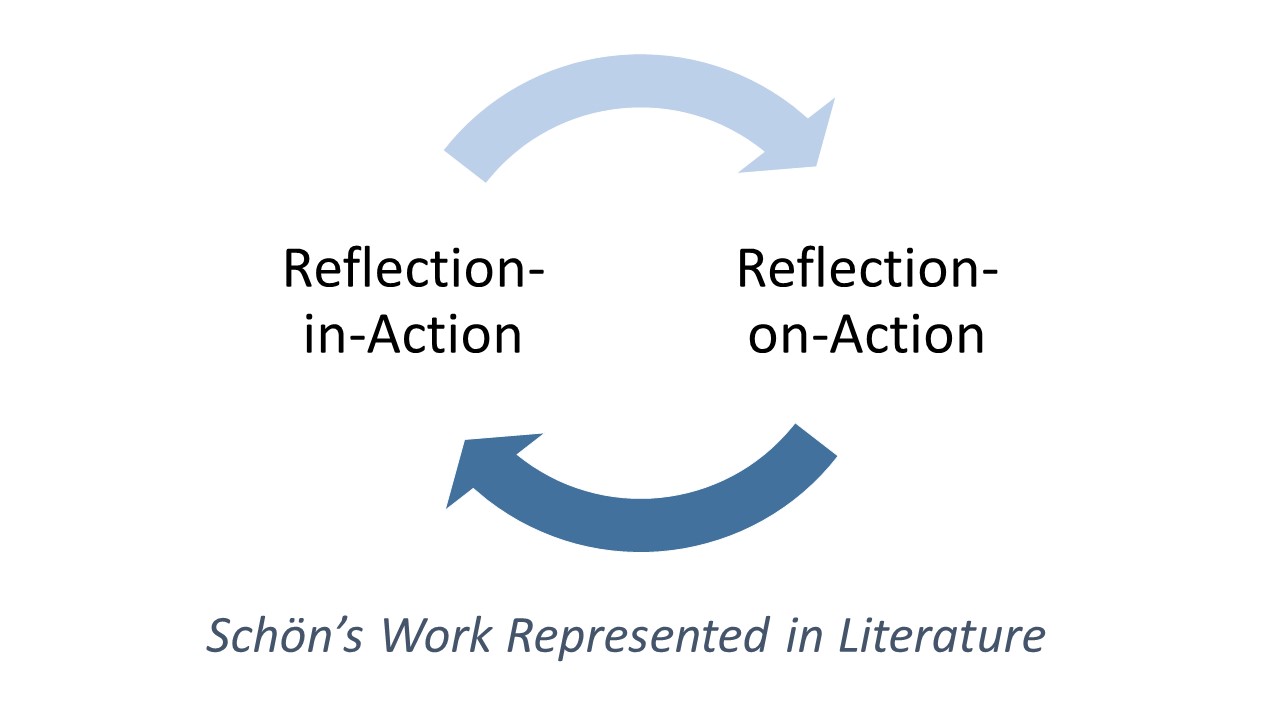 I was determined to increase my personal capacity to reflect and teach reflection by choosing Schön’s seminal works, The Reflective Practitioner1 and Educating the Reflective Practitioner2. The centrality of reflection to my professional practice made this a natural decision. I hoped by reading these books I could help my learners become more reflective and ultimately better physicians. We had learned in class that Schön believes we learn through an iterative process of reflection-on-action (during action) and reflection–in-action (after the action). To date all of my reflections have been after the fact or on-actions.
Schön’s work is dense. It took me a great deal of time, effort, reading and rereading to get through his ideas. The more I read the more confused I became until I realized that Schön describes thinking theory rather than learning theory. His work gives a structured methodology for professionals to think-in-action, looking at each individual problem as unique requiring a unique solution. His work does not does describe how to learn new knowledge, skills or attitudes. Even more surprisingly is the minimal importance he places on reflection-on-action. Of the 355 pages of his original book only three pages describe on-action with rest of the book is about in-action.
By the time I finished mulling over Schön’s ideas the methods I used to reflect after the fact may not have changed but I now have entirely new reflective skillset to help me understand new problems as I encounter them. His work forms the basis of the methodology I hope to improve student empathy by using reflection during patient encounters.
- Schon D. The Reflective Practitioner How Professionals Think in Action. United States of America: Basic Books; 1983.
- Schon D. Educating the Reflective Practitioner. San Francisco: Jossey-Bass; 1987.
 Laurence Biro's reflections on Life, Universe and Everything